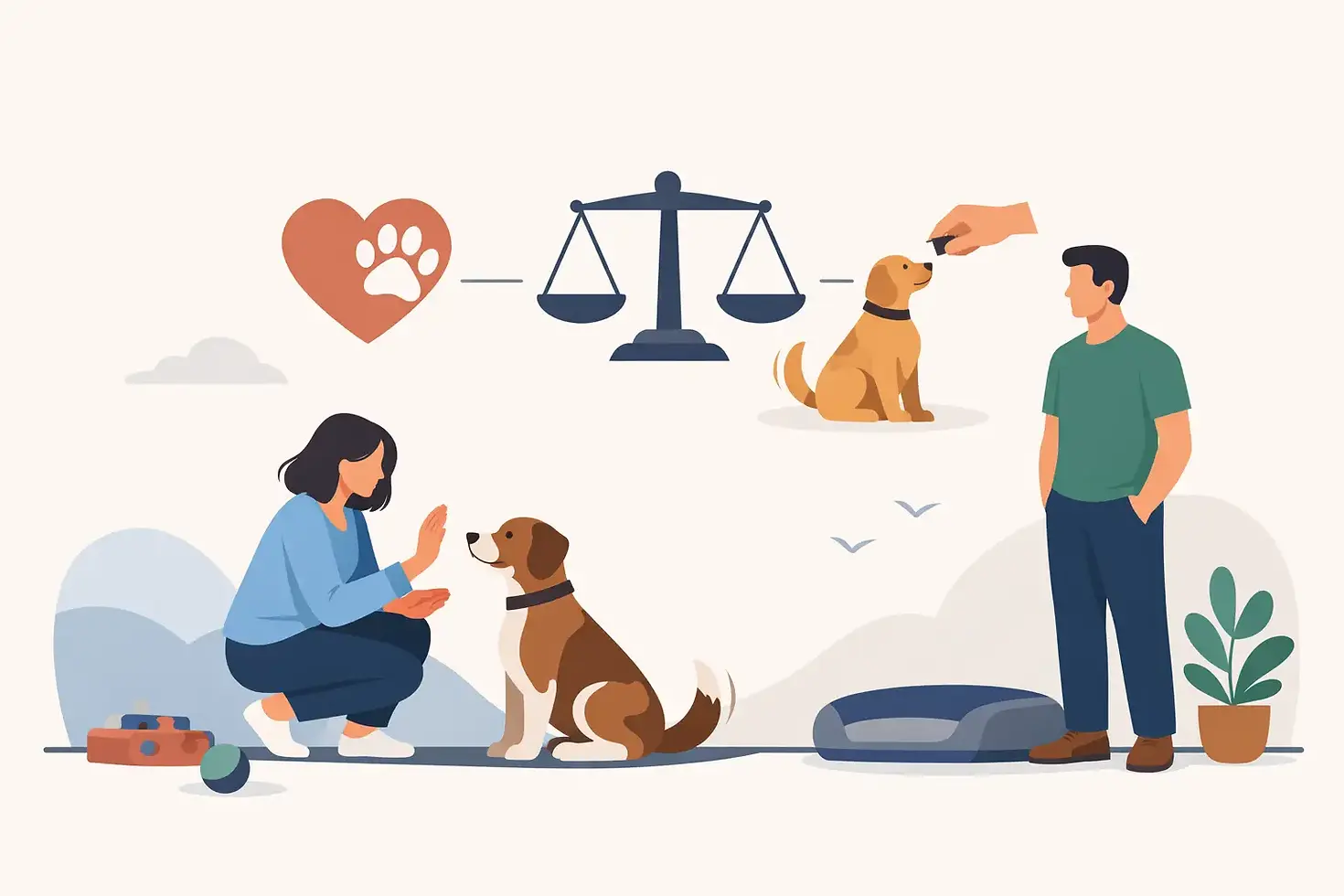
What Ethical Dog Behaviour Training Means
- Dominika Buczma

- May 22
- 6 min read
A dog that growls over food, panics when left, or lunges at other dogs is not being difficult for the sake of it. That behaviour is telling you something. Ethical dog behaviour training starts there - with the question of why the dog is behaving that way, not how quickly the behaviour can be shut down.
For many owners, that shift is a relief. It means you do not have to choose between having standards and being kind. Good training should absolutely improve behaviour, build reliability and make daily life easier. But it should do so without compromising welfare, damaging trust or relying on fear to force compliance.
What ethical dog behaviour training actually involves
At its core, ethical dog behaviour training is behaviour change built on welfare, learning science and honest assessment. It looks at the dog in front of you rather than forcing every case into the same method. That matters because a boisterous adolescent, a worried rescue dog and a highly driven working-bred youngster may all show similar outward behaviour for very different reasons.
An ethical trainer will want to understand context before prescribing exercises. That includes the dog’s health, genetics, early development, daily routine, stress levels, environment and handling history. If a dog is barking, snapping or avoiding contact, those details are not side notes. They are often the key to the case.
This approach also accepts that behaviour is not improved by punishment alone. Suppressing a warning sign may make a problem look smaller in the short term, while making the dog less safe or more conflicted underneath. A dog that has learned not to growl has not necessarily learned to cope.
Ethical training is not permissive training
This is where owners are sometimes given a false choice. They are told that if they do not use force, the dog will run the house. That is simply not true.
Ethical work still involves boundaries, structure and consistency. Dogs need clear information. They need rehearsal of the right habits. They need owners who follow through and do not change the rules from one day to the next. The difference is that the training plan is designed to teach the dog what to do, reduce the need for unwanted behaviour and set the dog up to succeed.
For example, if a young dog is charging at visitors, an ethical approach is not to ignore it and hope for the best. It may involve lead management, controlled greetings, place training, reward-based reinforcement for calmer behaviour and changes to the set-up so the dog can practise success rather than chaos. The dog still learns manners. The route there is simply fairer and more effective.
Why the root cause matters so much
The most common reason behaviour plans fail is that they focus only on the visible behaviour. Pulling on the lead, barking at the window, guarding the sofa, destroying the kitchen when left alone - these are outcomes. They are not always the actual problem.
Take reactivity as an example. Two dogs may both lunge and bark on walks. One may be fearful and trying to create distance. The other may be frustrated, over-aroused and desperate to get closer. If both dogs receive the same correction-based response, neither owner is really addressing the cause. In one case you risk increasing fear. In the other, you may add conflict without teaching self-control.
Ethical dog behaviour training asks better questions. What triggers the response? What is the dog gaining or avoiding? How much pressure can the dog cope with before tipping over threshold? Is pain, discomfort or poor sleep contributing? Once those answers are clearer, the work becomes more precise.
The role of stress, emotion and environment
Behaviour does not happen in isolation. Dogs learn through repetition, but they also respond to how they feel. A dog living in a constant state of over-arousal or anxiety will struggle to make good choices, no matter how many times an owner says no.
That is why ethical training often includes practical changes outside the formal exercises. Better rest, more predictable routines, safer management, more suitable enrichment and more thoughtful exposure to triggers can all make a marked difference. This is not avoiding training. It is supporting it.
Owners sometimes worry that management is a cop-out. In reality, sensible management prevents rehearsal of unwanted behaviour while new skills are being built. A dog cannot keep learning to explode at the front window if access is controlled. A puppy cannot keep stealing and shredding household items if the environment is set up properly. Prevention is part of good training, not a substitute for it.
What ethical dog behaviour training avoids
An ethical approach does not rely on fear, pain or intimidation to create obedience. That includes methods designed to startle, overwhelm or physically punish the dog into stopping a behaviour. The issue is not only whether those tools can interrupt behaviour. In some cases they can. The more important question is what they cost.
The trade-off may be increased anxiety, reduced trust, shut-down behaviour, redirected aggression or a dog that appears compliant but is not actually coping well. This is particularly concerning in behaviour cases involving fear, aggression or insecurity, where adding pressure can worsen the emotional state driving the problem.
That does not mean every dog should be handled in exactly the same soft, low-demand way. Ethical practice is not vague or sentimental. It means using the least intrusive, most effective approach for the dog in front of you, while keeping welfare and long-term outcomes at the centre of the plan.
Why one-to-one coaching often works better
Serious behaviour work is rarely solved in a group class. Group settings can be useful for general skills, especially for stable dogs who need practice around distractions. But where there is anxiety, aggression, guarding, separation issues or a significant lack of owner confidence, a more tailored approach is usually needed.
One-to-one coaching allows the trainer to assess the dog’s home environment, routines, triggers and handling in real terms. It also allows the owner to ask better questions and receive more precise guidance. That is often where the progress happens - not in generic drills, but in clear, practical changes that fit the dog and the household.
This is especially true when owners have already tried online advice, social media tips or classes that offered plenty of information but very little relevance to their actual dog. Behaviour work should not feel like guesswork.
Ethics also apply to expectations
A good trainer should be honest about what can be achieved, how long it may take and what owner involvement is required. That honesty is part of ethical practice too.
Some problems improve quickly once the right plan is in place. Others take time, repetition and careful handling over months rather than weeks. Genetics, health, age, learning history and environment all affect outcomes. There are dogs who may never love busy cafés, crowded parks or unfamiliar visitors in the home. Ethical training does not pretend every dog can become anything. It aims to produce the safest, most stable and most functional version of that individual dog.
For committed owners, that is often far more reassuring than being sold a quick fix. Lasting change comes from understanding, repetition and a plan that holds up in normal life.
Choosing the right trainer for ethical dog behaviour training
Credentials matter, but so does judgement. A trainer should be able to explain why they are recommending a method, what they are looking for in the dog’s behaviour and how they will adjust the plan if the dog is struggling. They should be interested in the whole picture, not just in stopping the obvious symptom.
It is also reasonable to expect professionalism. Clear handling, realistic advice, proper safeguarding around aggression cases and a willingness to refer on where veterinary input is needed are all part of responsible practice. If a trainer dismisses stress signals, guarantees rapid results, or treats owner concern about welfare as weakness, that should give you pause.
At Dog’s Perspective, this principle is simple: train the dog in front of you, respect what the behaviour is telling you, and build change that the owner can actually maintain.
Ethical dog behaviour training is not a softer alternative to real training. It is real training - informed, disciplined and rooted in canine welfare. When it is done properly, you do not just get fewer unwanted behaviours. You get a dog that understands more, copes better and can trust the person guiding them through the process. That is the kind of progress worth working for.


Comments