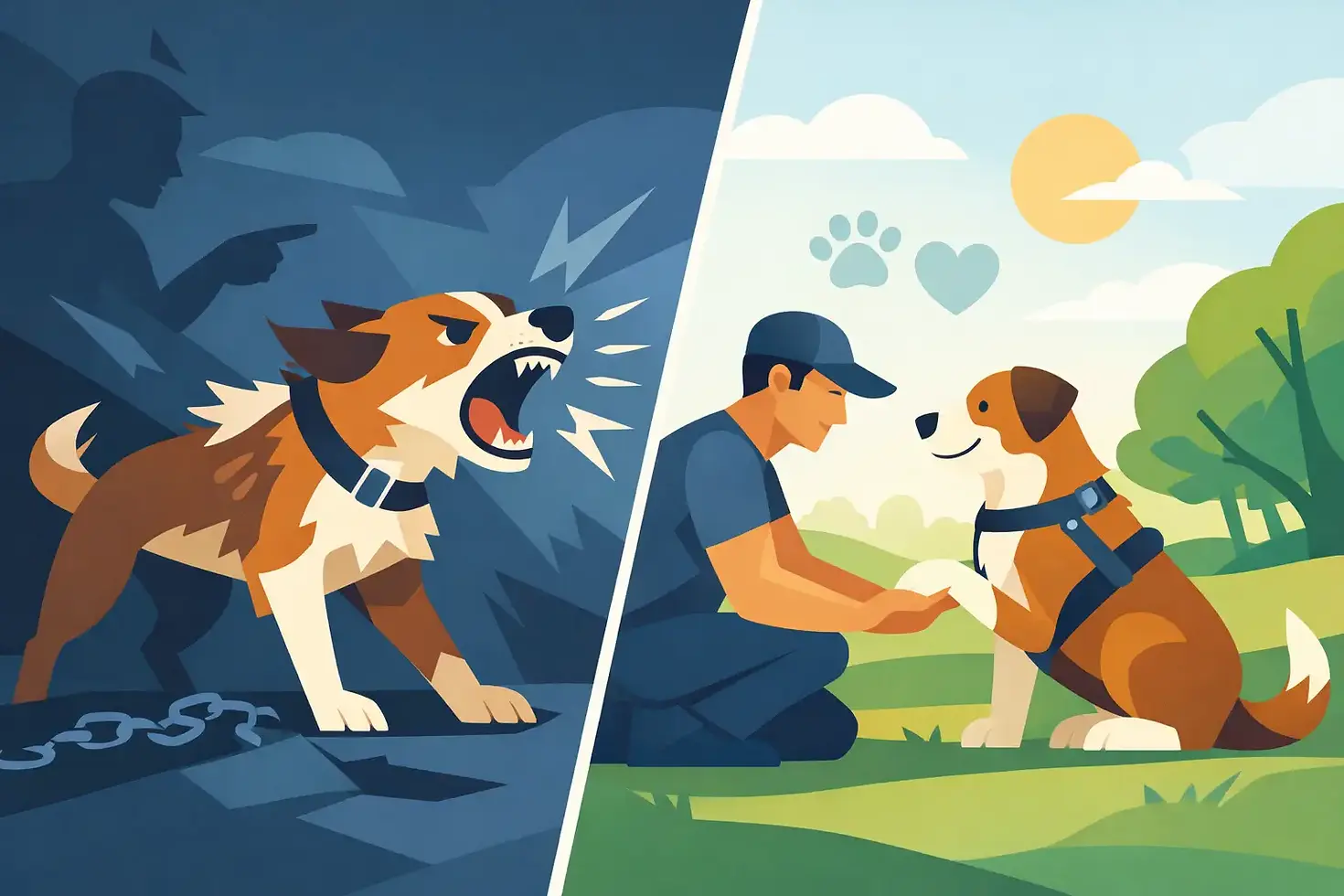
Can Dog Aggression Be Rehabilitated?
- Dominika Buczma

- Jun 13
- 6 min read
A dog that growls at visitors, lunges on lead, or snaps over food can leave owners feeling shaken, embarrassed and, at times, guilty. One of the first questions people ask is can dog aggression be rehabilitated, or is this simply who the dog is now? The honest answer is that many aggressive dogs can make meaningful, lasting progress, but the outcome depends on why the behaviour is happening, how long it has been rehearsed, and how committed the owner is to a proper plan.
Aggression is not a single diagnosis. It is a behaviour with a function. Dogs use it to create distance, protect access to something valuable, defend themselves when they feel threatened, or cope with conflict they do not know how to handle calmly. That matters, because rehabilitation is never about suppressing warning signs and hoping for the best. It is about understanding what is driving the behaviour and changing the dog’s emotional response, decision-making and daily habits over time.
Can dog aggression be rehabilitated in every case?
Not in every case, and it would be irresponsible to promise that. Some dogs improve to the point that they can live safely and comfortably in situations that used to overwhelm them. Others become far more manageable, but still need clear boundaries, careful handling and sensible management for life. In severe cases, especially where there is a long bite history, poor genetics, chronic pain or repeated rehearsal of aggression, the goal may be risk reduction rather than complete social normality.
That does not mean rehabilitation has failed. For many families, success looks like a dog that can relax at home, walk past triggers without exploding, tolerate visitors under a clear routine, or be safely handled without conflict. Progress should be measured against the individual dog, not against an unrealistic idea that every dog must become universally sociable.
What aggression usually tells us
Owners are often told their dog is dominant, stubborn or trying to take charge. In practice, aggression is more commonly linked to fear, frustration, insecurity, conflict, over-arousal, guarding behaviour, pain, or learned expectations about certain situations.
A dog that reacts to other dogs on walks may not want a fight at all. He may be frightened, trapped on lead, and trying to keep distance. A dog that snaps when moved off the sofa may be guarding a resting place, or he may be sore and anticipating discomfort. A dog that bites when a child hugs him is not being spiteful. He is communicating that he cannot cope.
This is why proper assessment matters. If you treat all aggression as disobedience, you miss the reason it is happening. When you miss the reason, training becomes unfair and often less effective.
Common causes behind aggressive behaviour
Fear-based aggression is one of the most common forms seen in pet dogs. These dogs often look bold on the surface, but their behaviour is defensive. Resource guarding is another frequent issue, involving food, toys, space, beds, or even people. Frustration can also build aggression, particularly in dogs that are highly aroused, under-stimulated, or repeatedly allowed to practise frantic behaviour around triggers.
Pain and medical issues should never be overlooked. Orthopaedic discomfort, skin irritation, gastrointestinal pain and endocrine problems can all affect tolerance and behaviour. If a dog’s responses have changed suddenly or intensified without obvious reason, a veterinary check is a sensible place to start.
What rehabilitation actually involves
Rehabilitation is rarely a quick fix. It is usually a combination of management, behaviour modification, owner education and consistent follow-through at home. The best plans are tailored, because the details matter. Two dogs may both lunge at visitors, but one may need confidence building and predictable introductions, while the other needs stricter boundaries, calmer routines and work on impulse control.
Management comes first because safety matters. That may mean using a lead indoors for certain scenarios, changing walk locations, preventing access to triggers, introducing a muzzle properly, or stopping situations that repeatedly push the dog over threshold. Management is not giving up. It is how you create the space to teach better behaviour.
Behaviour work comes next. This often includes changing how the dog feels about a trigger through carefully controlled exposure, teaching alternative responses, rewarding calm choices, and improving the dog’s ability to disengage and recover. It may also involve work on handling, boundaries in the home, rest, enrichment and clearer routines.
Owner coaching is a major part of the process. Dogs do not live in training halls. They live in kitchens, hallways, front gardens and local footpaths, where timing, consistency and calm handling make a real difference.
Why quick fixes often make aggression worse
When owners are worried, it is understandable to want fast results. The trouble is that aggressive behaviour often sits on top of stress, confusion and rehearsal. Heavy-handed methods may interrupt behaviour in the moment, but they do not resolve the cause. In some dogs, they increase anxiety and make the warning signs less obvious before the next bite.
Equally, a purely permissive approach can fall short. If a dog has no structure, no clear guidance and repeated chances to rehearse aggressive behaviour, improvement is unlikely. Good rehabilitation sits between those extremes. It is fair, clear, practical and rooted in welfare.
A disciplined plan does not mean harshness. It means being precise about what the dog can cope with, what needs to change, and what the owner must do consistently.
Can dog aggression be rehabilitated at home?
Parts of the work happen at home, but serious aggression should not be left to guesswork. Owners play the central role because they are with the dog every day, yet an experienced behaviour professional can identify patterns that are easy to miss when you are living with the problem.
For example, many owners focus only on the outburst itself. In reality, the build-up starts much earlier - scanning, freezing, hard staring, weight shift, closed mouth, increased pace, conflict signals. Catching that earlier picture allows training to start before the dog is fully committed to aggression.
A good in-home consultation can also assess the environment properly. Layout, routines, feeding, sleeping arrangements, visitor patterns and household handling all shape behaviour. That level of detail is difficult to cover with generic advice.
What affects the outcome?
Several factors influence how far a dog can come. Age matters, but not always in the way people think. Young dogs can improve very well because habits are less fixed, but adult dogs often make excellent progress too when the plan is accurate and the handling changes.
The dog’s genetics and early experiences matter. So does the severity and frequency of the behaviour. A dog that has been barking and lunging for six months is often a different case from one that has bitten multiple people over several years.
The owner’s consistency matters just as much. Rehabilitation can stall if the dog is following one set of rules one day and another the next, or if family members keep putting him into situations he cannot handle. Progress usually comes from many well-managed repetitions, not one dramatic breakthrough.
Signs a dog is improving
Improvement does not always look impressive at first. It may be a softer body posture, quicker recovery after seeing a trigger, fewer hard stares, better disengagement, or the ability to take food and think instead of reacting instantly. Those changes are significant because they show the dog is processing differently.
Over time, that can lead to safer behaviour in real life. Walks become more predictable. Handling becomes less tense. The household starts to feel calmer. Those are meaningful results, even if the dog still needs some lifelong management.
When owners should seek help promptly
If a dog has bitten, attempted to bite, guards resources intensely, reacts unpredictably, or shows aggression around children, do not wait for it to sort itself out. Behaviour that is rehearsed tends to become more established. Early intervention usually gives you more room to work and more ways to keep everyone safe.
It is also worth seeking support if you find yourself changing your whole life around the dog, avoiding normal activities, or feeling anxious about handling him. Owners need guidance as much as dogs do. Clear coaching reduces stress on both sides and helps rebuild trust.
At Dog’s Perspective, this kind of work is approached as rehabilitation rather than a box-ticking training exercise. That means looking at the root cause, building a realistic plan, and supporting the owner through the stages that follow, not just delivering advice and disappearing.
Aggression can be frightening, but it is not always the end of the road. Many dogs can learn safer responses, feel more secure, and live far more settled lives with the right structure and support. The most useful place to start is not with the question of whether your dog can be made perfect, but whether he can be understood properly and helped fairly from where he is now.


Comments